Evidence, not recall.
Your patients don't stop having menopause between appointments. Menovē gives you between-visit visibility: a month of her days as a structured one-page summary, with what needs your eye already flagged. Built for the fifteen-minute reality of your clinic, with no portal, no password, and no change to your workflow. Time saved at her next appointment is time spent treating.

We asked clinicians what a patient-kept record would have to do. This is what they said.
Seventeen clinicians who see women in the menopause transition every month, in family medicine, women's health, internal medicine and general practice, answered a survey about what they are missing in the visit.
Rated a one-page patient-generated summary 4 or 5 out of 5 for helping them care for these patients.
Answered that it would meaningfully save time in the appointment itself.
Only one said patients often bring their own symptom records. The rest said sometimes or rarely.
The clinicians most confident the visit reflects her months were the same ones who said symptoms go unmentioned.
Confidence and completeness are not the same thing. This is not a failure of attention. You cannot account for what you were never told.
ON RECALL"Patients often rely on recall, which can be inaccurate due to fluctuating symptoms, and limited appointment times make it tough to capture the full timeline."Women's Health Nurse Practitioner · 17 years
ON SEEING IT SOONER"A daily record of her hot flashes, sleep, mood, and any medications she was taking would have helped me see patterns sooner and adjust her treatment more quickly."Family medicine physician · 10 years
ON WHAT MAKES IT USABLE"Consistent entries with specific details like date, time, duration, severity, and potential triggers."Women's Health Nurse Practitioner · 17 years
ON FORMAT"Keep it scannable at a 5 second glance and ensure it highlights trends instantly."Women's Health Nurse Practitioner · 17 years
Survey of 17 practicing clinicians, fielded 2026. Fourteen rated themselves 4 or 5 out of 5 on whether the visit reflects what she actually experienced; thirteen of those fourteen also reported that at least some patients have symptoms they never raise. Respondents were recruited independently and were shown a description of the record, not the product; none are affiliated with Menovē. Quotations are their own words, lightly corrected for spelling. Figures are counts out of 17, not a representative national sample.
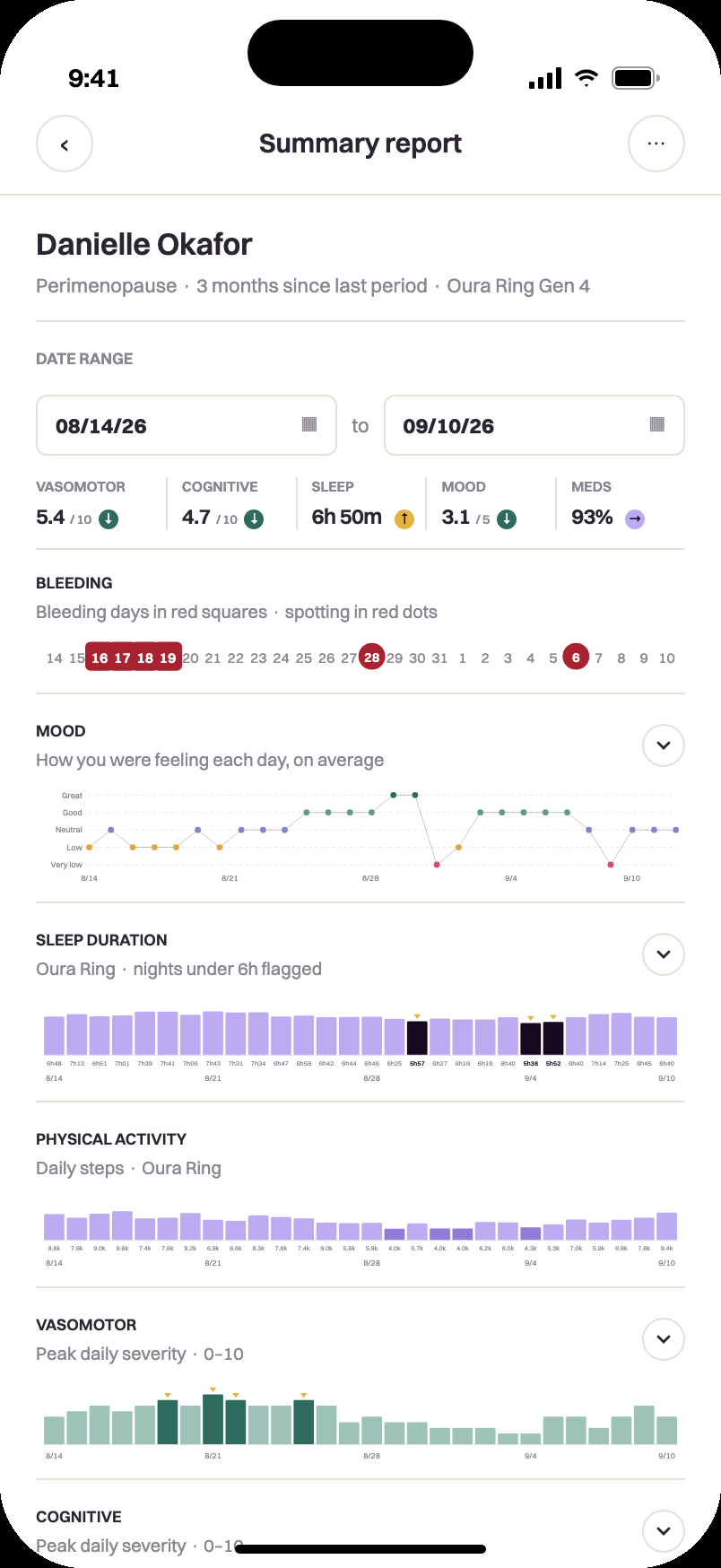
Her month, in your language. Review from paper, email, or a QR code.
A structured, longitudinal summary: symptom frequency, pairings, sleep and cycle context, what she tried, what changed since her last visit, flagged, and her own words, kept verbatim beside the structured signs. Patient-reported, dated, and organized for the chart, not a memory test.
Her wearable comes with it: sleep, resting heart rate, and temperature, summarized over the same window, so the report arrives grounded in more than recall.
The record is patient-owned and patient-shared. You read; she controls.
Sent ahead, by email
Her summary reaches your office ahead of the appointment, so the review happens at chart prep, not in the hallway.
Printed, or a PDF
She brings the one-pager to the visit like a lab result. Nothing for you to install, join, or remember.
Scan her QR
She taps "Show my doctor." You scan with your phone or tablet and her read-only record opens in seconds. She grants it; she can revoke it.
Patient-directed sharing
When she shares her record with you directly, the record stays hers: no business-associate relationship, no new obligations for your practice beyond the PHI duties you already carry.
With the dashboard: her days, streaming in.
A standing roster of your Menovē patients, wearable data day by day, changes flagged the week they happen, and a monthly digest per chart. Every path above receives the report; the dashboard adds between-visit visibility.
See the clinical dashboard →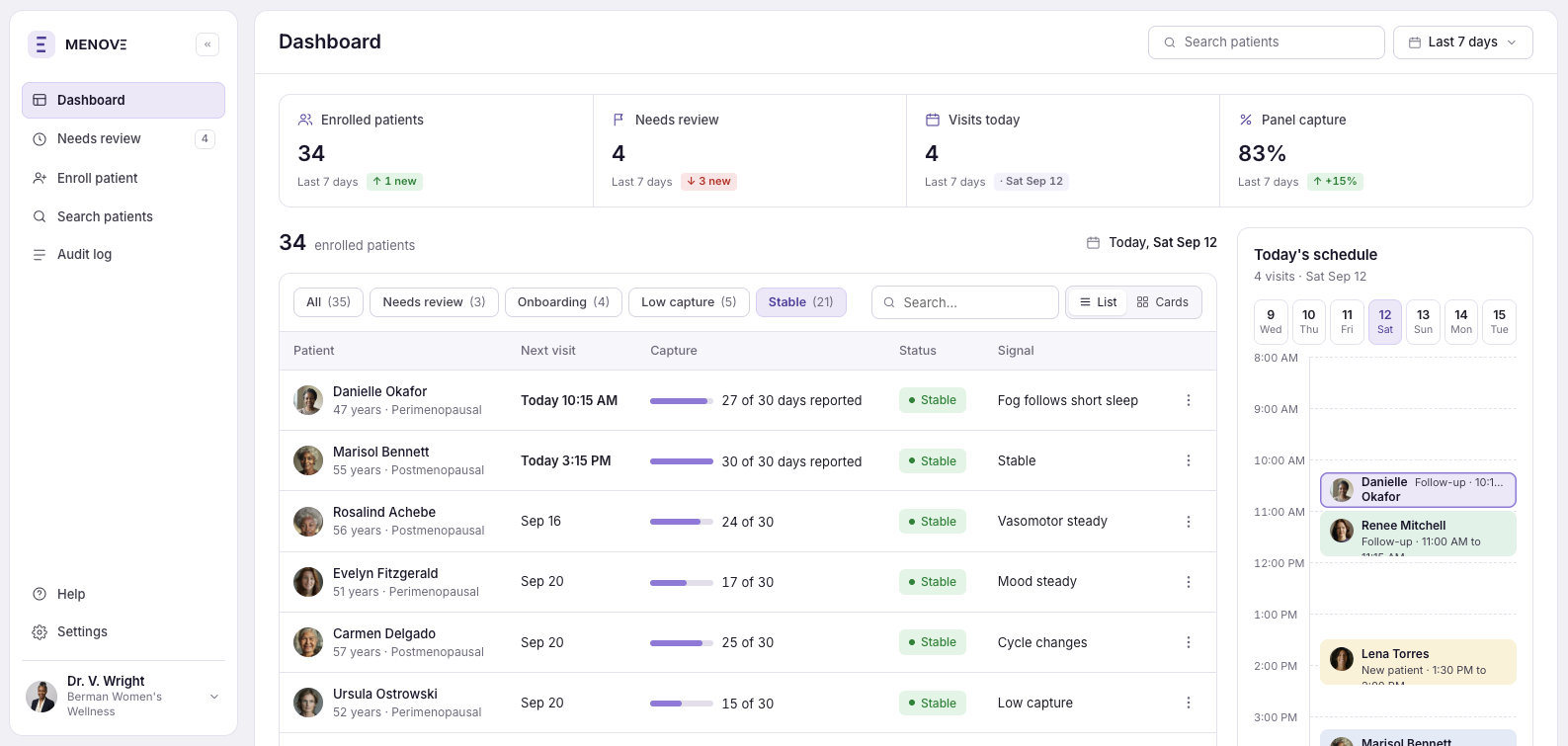
Good medicine, good business.
Chart prep, not fifteen: her history arrives structured, trended, and flagged before she sits down. The visit starts at the conversation, not the reconstruction. Minutes saved at the visit are minutes spent treating.
What a practice nets per enrolled patient per month under standard care-management billing, after the Menovē fee. The software funds itself through care your patients already qualify for.
Illustrative, based on 2026 national CCM rates; coding decisions belong to your billing team. Cash-pay practices price Menovē into membership as a between-visit differentiator.
Midlife women quietly change practices when they feel unheard, and take their families' charts with them. Being the clinic that reads her record, and acts on it, is retention no ad spend buys.
A small group of founding practices.
- A 90-day paid pilot with a first cohort of your patients, priced per enrolled patient in blocks of five
- Direct line to the founder; your feedback shapes the clinician view
- Setup measured in minutes, not committee meetings
- Founding-practice pricing locked in as we grow
Is this a medical device?
No. Menovē is a General Wellness product: it keeps her record and organizes what she reports. It never diagnoses, treats, or recommends therapy. The clinical judgment in the room stays yours.
Does it need my EHR?
No. Every delivery path works without integration. When your system is ready for one, the data is FHIR-shaped and prepared for it.
Who owns the data?
She does. She grants access, she revokes it, and your practice's copy is governed the same way any patient-provided record is. The dashboard view is different: enrolled practices operate under a business-associate agreement, and panel data is governed by that agreement.