
The record is not for you to prove yourself. It is for them to see you.
We asked seventeen clinicians who treat women in this transition what would actually change their care. Their answers are why Menovē exists.
9 in 10 said a record of your months, kept in your own words, would help them care for you. Thirteen of the seventeen said it would save time in the appointment itself.
"People often forget to report stuff on menopause due to various reasons. Having a really easy way to log menopause symptoms would make it easier for both parties."Family Nurse Practitioner · 5 years
"She withheld sharing full symptoms and reported occasional flashes, which I treated as mild. Full info would have changed the whole response and treatment."Registered Nurse · 3 years
"A record is useful if it is consistent and includes dates, symptoms, and severity. I review it to look for patterns, such as how often symptoms happen and whether they are getting better or worse."Family medicine physician · 10 years
Survey of 17 practicing clinicians, fielded 2026. Sixteen of the seventeen said at least some of their patients have symptoms they never mention in the visit. Respondents were recruited independently and none are affiliated with Menovē. Quotations are their own words, lightly corrected for spelling.

You keep it. Your clinician can finally read it.
- 01
You log your day
Thirty seconds, in your own words. No forms, no scores to memorize.
- 02
Mona finds the pattern
Each entry is lined up against your sleep, cycle, and movement until a pattern earns the word "confirmed."
- 03
Your clinician receives evidence
A structured summary in clinical language, not a memory test in a fifteen-minute slot.
Thirty seconds a day. Proof.
Every check-in goes into your record. Check-ins add up to patterns; patterns become a report; the report becomes a different kind of appointment. An app that moves you toward better support: quiet day to day, clinical when it counts.
- CHECK IN
- Say the day in your own words. Mona does the sorting, no dropdowns, no diagnosis quiz.
- BOOST
- One small, doable thing, matched to how today actually feels, set aside without guilt when it doesn't.
- REFLECT
- The shape of today, named. Steady, tender, bright, heavy, your word, kept verbatim.
- INSIGHTS
- Patterns rise from your check-ins, and go with you to the visit as a report your doctor can use.
A conversation. Your words, kept verbatim.
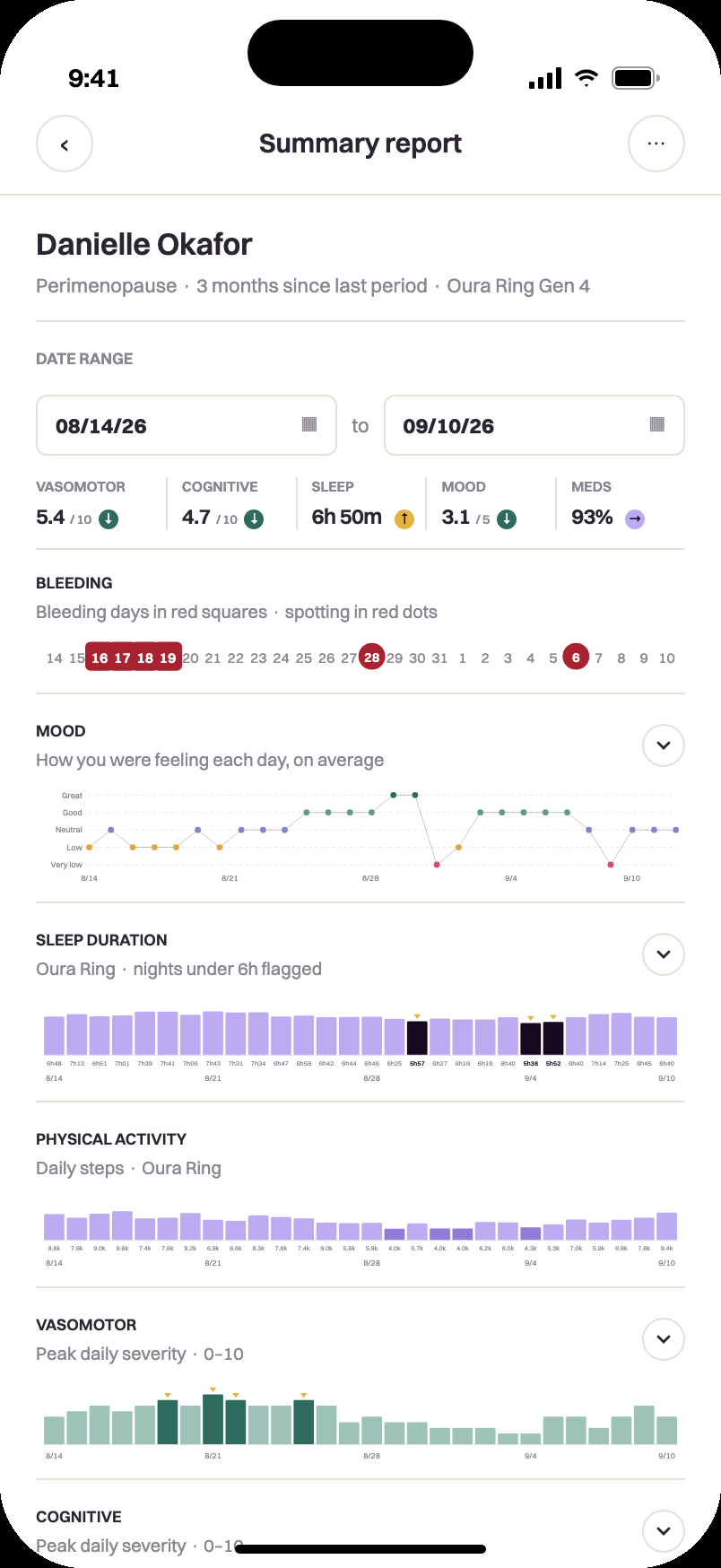
A report. Structured, dated, in their language.
You were never imagining it. You just never had it written down.
The average woman spends years being told her symptoms are stress, or age, or nothing. A written month changes the conversation.
Your summary reaches the office before the visit, at chart prep.
In your hand, brought to the visit like a lab result.
Read-only, in the room. You grant it; you can revoke it.
Start the record your next appointment deserves.
Join the beta and we'll save you a place in the next cohort, and send The Cairn, our monthly letter, while you wait.